Thena.ai
Two years as the founding (and only) designer at an AI-native customer support platform backed by Lightspeed and First Round. Joined as the first design hire, expanded into product, growth, and front-end.
- role
- Lead, Design & Growth
- when
- Nov 2023 – Dec 2025
- stack
- React, Next.js, Figma, Framer
- status
- Past
Customers
Vanta, Braze, Vercel, Mixpanel, ClickHouse, Launchdarkly.
Outcomes
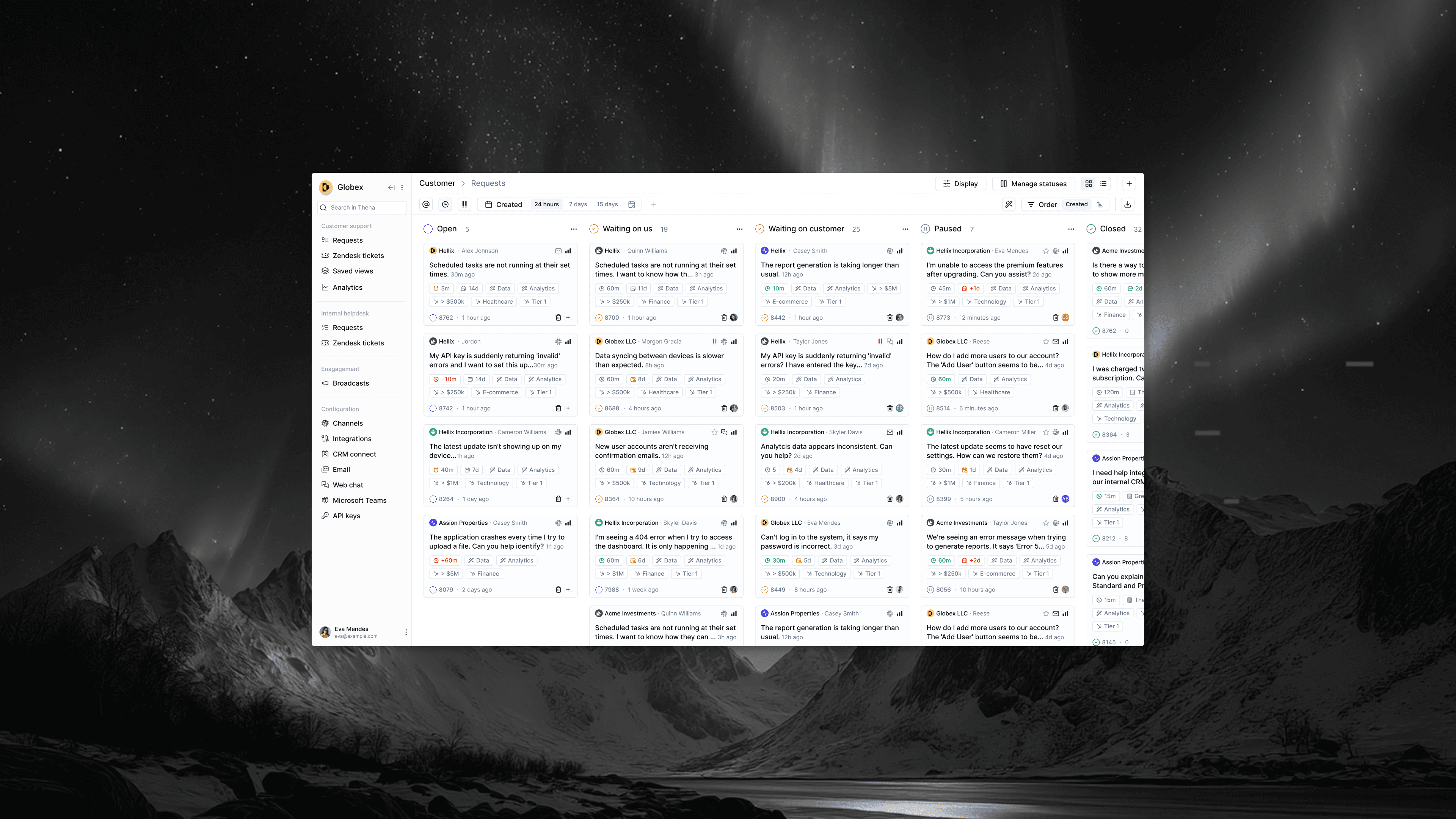
- 20x product usage (600 → 12,000 min/week) after a complete UI overhaul
- 40% activation rate from onboarding flows
- 50% conversion to paid
- Near-100% adoption on the AI features I designed: agent workflows, copilot, sentiment analysis
Case studies
The three deep dives, preserved from the original site:
What I owned
The UI overhaul
When I joined, the product worked but it didn't show its work. The AI surfaces (agent workflows, copilot, sentiment) were buried behind tabs, modals, and patterns that assumed you already knew what to look for. The dashboards were dense in the wrong places and thin where the value lived.
I rebuilt the core surfaces top to bottom: the inbox, the agent workflow builder, the copilot panel, the analytics views. The frame was simpler. The AI features came to the top, with the conversation Thena's agents were actually having visible alongside the human one. Friction in daily use went down a lot.
The 20x (600 → 12,000 minutes per week, per the product analytics) wasn't a single hero feature. It was the compounding effect of the AI tools finally being discoverable, the day-to-day inbox feeling lighter, and customers spending real time inside the product instead of bouncing off the surface.
Onboarding flows, lifecycle, in-product prompts
Activation was the bottleneck. People signed up, poked around, and didn't connect Slack, didn't set up an agent, didn't see the thing the product actually did. I rebuilt onboarding as a guided path with one clear next action at every step, and paired it with lifecycle emails and in-product prompts that surfaced the right nudge at the right moment.
The numbers landed at ~40% activation and ~50% conversion to paid. Honest read: most of the lifecycle emails didn't move the needle on their own. The wins came from a small number of high-leverage touchpoints: the first-session setup flow, the prompt that fired when a workspace had agents configured but no traffic, and the email that went out the day someone hit their first resolved AI ticket.
Shipping production React/Next.js
This is the part of Thena I'm most proud of. As the only designer, I kept hitting the same wall on handoff: the design intent got diluted in translation, and the cost of experimentation was too high. Small details didn't match. Larger ideas died in backlogs because nobody could justify the engineering time on something speculative.
So I started vibe coding with Cursor and Claude, translating design intent directly into working code. The goal was never to become an engineer, it was to close the gap. I started in prototypes outside the main codebase, got access to production, and ended up shipping three features end-to-end:
- AI Web Chat Widget: the embeddable agent surface that goes on customers' sites. Three separate APIs, a tricky local setup, and a deployment story that needed to feel one-click. I built the configuration UI and the code-generation layer that turns preferences into a deployable snippet. 48 of 76 orgs adopted it.
- AI Chat Threads: a way for customers to see the invisible conversations between their end users and the AI. HTML inside JSON, real pagination, filters, virtualization for performance. Split-view interface with feedback controls. All 48 orgs using the widget used this to monitor what their AI was doing.
- Broadcast: rebuilt mass messaging to support both Slack and email (it had been Slack-only). No docs, backend bugs to surface and fix, under a week to ship. I did manual API testing, filed bugs, redesigned the flow, and shipped it on time.
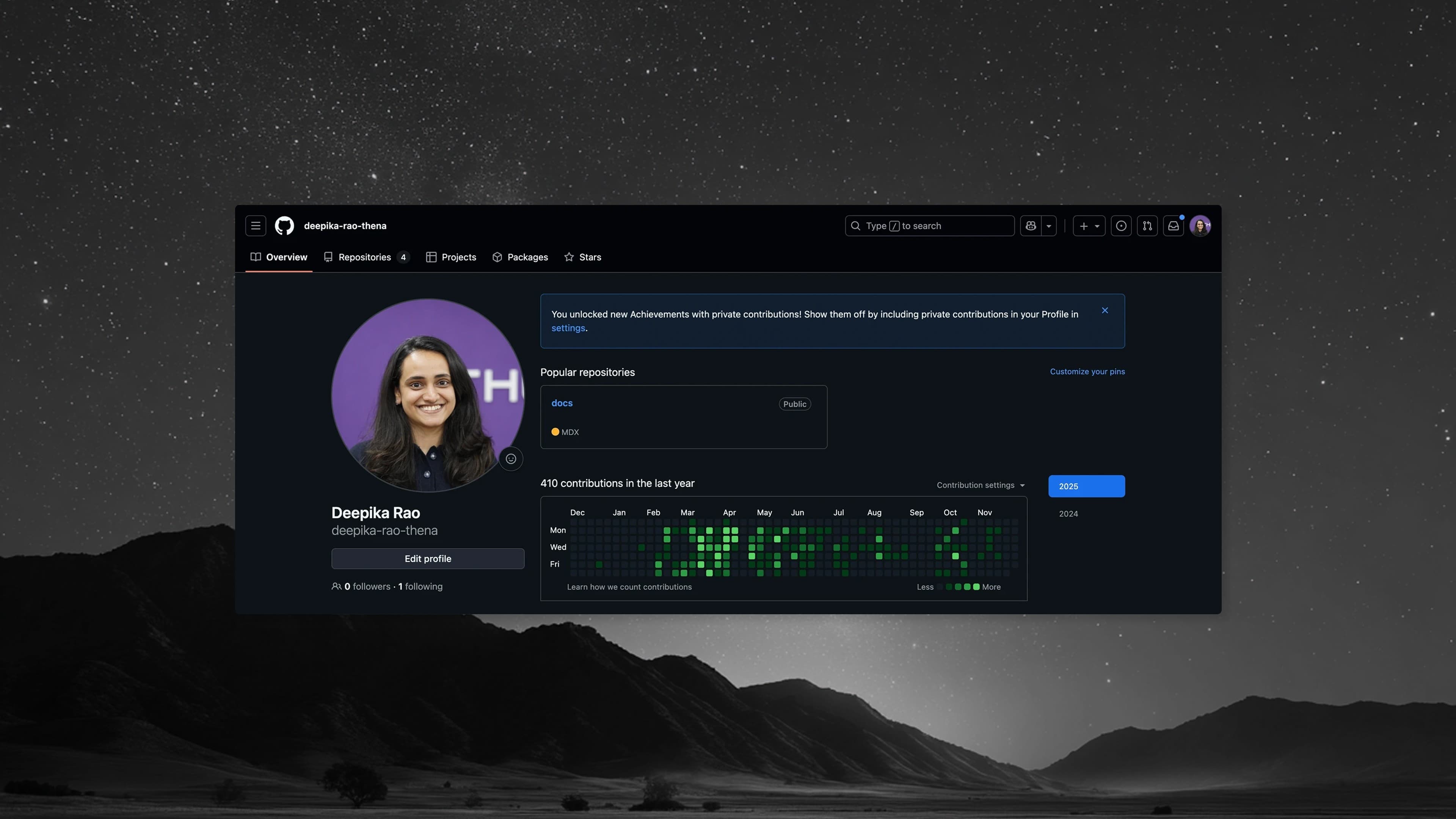
The workflow shifted from "design in Figma → hand off → wait → review → wait → hope it matches intent" to "have an idea → build it → test it → ship it." QA cycles that used to take weeks collapsed to days. 410 GitHub contributions in 2025.
The engineering team's initial skepticism was real, and it showed up as extra PR scrutiny in the first few weeks. It turned into trust once they saw I wasn't trying to take their jobs, I was trying to help us ship faster.
Designing AI features
Near-100% adoption on the AI surfaces I designed: agent workflows, copilot, sentiment. Designing for AI turned out to be a different job than designing a normal SaaS feature. The work is confidence and visibility, not pixel polish. Can the user see what the AI is doing, can they tell when it's wrong, can they intervene without feeling like they're fighting it?
That's what AI Chat Threads was really about. The agent was making decisions inside customer conversations, and the only way the human team could trust it was to watch it work. Once they could, the trust compounded, and so did the usage.
Website, growth funnel, pricing experiments
I owned the Framer site and the full funnel from landing page to onboarding to payment. Ran pricing experiments at the bottom of the funnel: different price points, different package shapes, paywall positioning.
The honest takeaway from the pricing work: willingness to pay and activation depth are not the same lever. The experiments that moved revenue weren't always the ones that increased conversion. Sometimes a higher price filtered for users who actually used the product, which moved retention and net dollar retention in a way a conversion-only view missed.
Reflections
The skill I built at Thena was closing the gap between an idea and a real thing. Vibe coding made me a designer who can bring ideas to life directly, without losing them in translation.
What I'd do differently: I'd push for production code access earlier. The first six months I held back from writing anything that would ship, and in hindsight the gap between "designing it" and "watching someone else build a diluted version of it" was already costing us velocity I could have reclaimed.
I'd also be more disciplined about killing lifecycle emails that weren't pulling weight. The activation and conversion wins are clean numbers, but they hide how much noise we ran alongside the few touchpoints that actually mattered.
What I carried to Potential: small surface area, high leverage, AI in every workflow that benefits from it. And the through-line, which is that if I can design it I can build it, so the cost of trying things stays small enough that we try more of them.